Why we open-sourced our AI agent gateway
Published 12 May 2026 · Editorial update 6 September 2026 · 2 min read · Enternovate
An agent works with more than a chat prompt. It can access files, tools, credentials and business context. Teams need to understand that access before they trust it with useful work. Open code makes inspection and adaptation possible.
Xavani Agent is MIT-licensed and local-first. Its local configuration and working state live under ~/.xavani. Zero product telemetry is not the same as zero network traffic: remote models and connected services receive the requests you configure.
Start with a narrow tool set and explicit approval for consequential actions. Inspect the permissions, execution backend and logs in your installed version. Open source enables review; it is not proof that every deployment is secure.
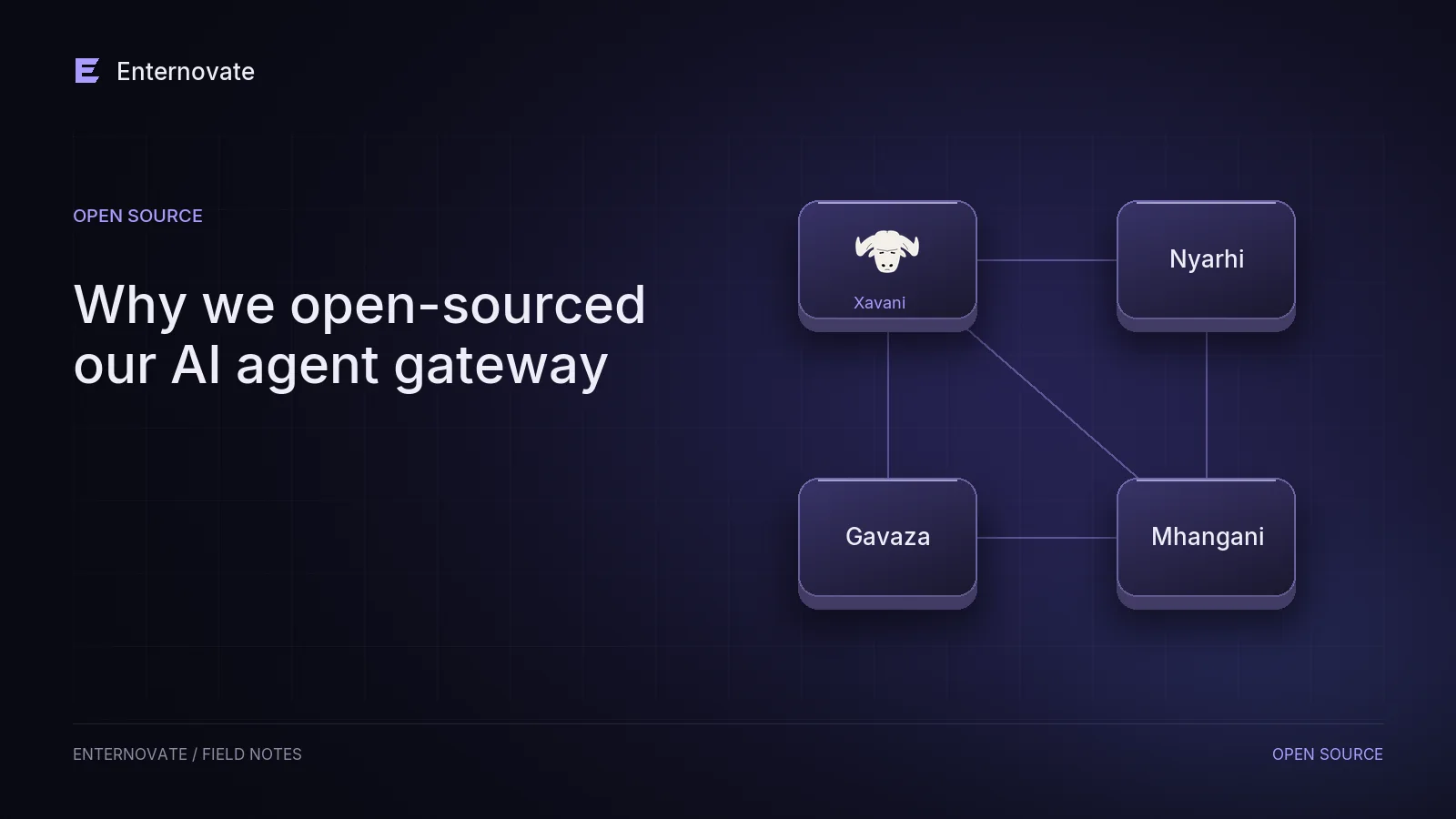
The local ecosystem has distinct roles. Xavani is the agent, Nyarhi is the knowledge graph and memory layer, Gavaza supports POPIA compliance work, and Mhangani audits web security. Check each project's documentation before assuming an integration is automatic.
A useful contribution can be a reproducible issue, a test, a documentation correction or a patch. The aim is a tool that users can understand and improve, rather than a black box they must accept on trust.